

Quick answer:
Hang gliding is an accessible adventure sport where trained pilots fly a fabric wing using wind and thermals—no motor required. Beginners can start safely with certified instructors at world-class schools like Kitty Hawk Kites in North Carolina or Lookout Mountain Flight Park in Tennessee, beginning with gentle dune lessons or tandem flights before progressing through structured skill levels.
Dreaming of soaring like a bird but unsure where to begin? You’re not alone. Many first-timers feel a mix of excitement and hesitation when they picture themselves running off a hill with a giant wing strapped above them.
The good news is that hang gliding is far more approachable than it looks—and you don’t need superhuman strength or fearless nerves to get started.
This guide walks you through everything a beginner needs to know: how hang gliders actually work, the gear involved, how to choose a reputable school, and the best beginner-friendly destinations in the United States. By the end, you’ll have a clear, confident roadmap for your first flight.
Understanding the Basics of Hang Gliding
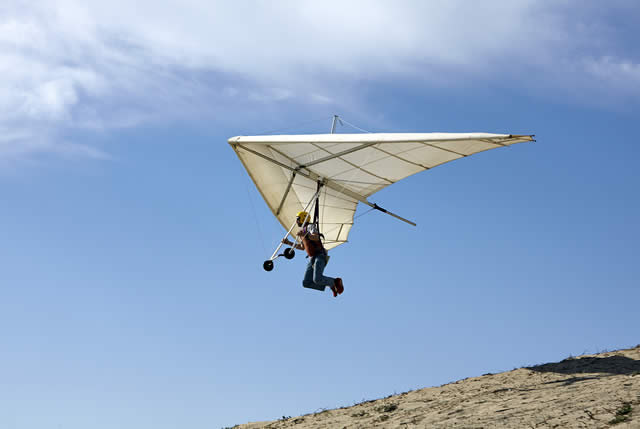
Hang gliding is an air sport in which a trained pilot flies a glider using only wind and thermals to stay aloft. There’s no engine involved—not even to get into the air. The pilot hangs securely in a harness beneath a wing roughly nine metres across, made of fabric stretched over an aluminum or graphite frame.
Steering is surprisingly intuitive. You control the glider by shifting your body weight, moving like a pendulum beneath the wing. Shift left, and the glider banks left.
Pull yourself forward through the A-frame and you speed up; push it away and you slow down. As the team at Kitty Hawk Kites puts it, you steer by shifting your weight and control your speed with the bar—"that’s just about it."
Pilots get airborne in three main ways. Foot launching involves running down a gentle slope into the wind until the wing lifts you. Surface towing uses a vehicle, winch, or boat to pull the glider up.
Aerotowing has a small powered aircraft tow the glider to between 1,000 and 3,000 feet before release. Once aloft, pilots stay up by riding two kinds of lift: dynamic lift, created when wind rises against a slope, and thermal lift, generated when the sun warms the ground and sends columns of warm air upward.
A complete glider weighs between 26 and 35 kilograms—about the weight of an overpacked suitcase. Lightweight, controllable, and elegant in the air, it’s the closest most people will ever get to flying like a bird.
Essential Gear for Your First Flight
The encouraging news for newcomers is that you don’t need to buy anything to start. Reputable schools supply all the essential equipment for lessons and tandem flights, including the glider, harness, and helmet.
The core pieces are straightforward. The wing is your aircraft. The harness suspends you safely beneath it and keeps your body comfortable throughout the flight. A helmet protects your head during takeoff and landing, the two phases where most contact with the ground occurs.
As you progress toward solo flying, you may also add a variometer—an instrument that signals when you’re climbing or sinking—and gloves for warmth at altitude.
What you wear matters more than what you bring. For dune lessons in warm, sandy conditions, light breathable clothing and closed-toe shoes work best.
For tandem flights at higher altitudes, where wind chill is noticeable, comfortable layers like a sweatshirt or light jacket are smart. Tuck in loose strings, keep jewelry to a minimum, and bring water to stay hydrated.
Finding a Reputable Hang Gliding School
Choosing the right school is the single most important decision a beginner makes. In the United States, look for instructors certified by the United States Hang Gliding and Paragliding Association (USHPA). USHPA certification means your instructor has completed extensive training and meets recognized safety and teaching standards.
A quality school will start you slowly. Expect ground school first, where you learn the fundamentals, followed by short flights on gentle training hills before you ever attempt anything higher. Instructors should be patient, attentive, and ready to adjust the pace to your comfort.
One Kitty Hawk Kites guest praised how instructors worked "with such understanding and patience" to help an autistic participant get airborne through many small, careful steps—a good sign of a school that puts people first.
Before booking, confirm the school’s certification, ask about instructor experience, and check that they monitor weather closely. Hang gliding depends entirely on wind and conditions, so a trustworthy school will reschedule rather than fly in unsafe weather.
Beginner-Friendly Hang Gliding Destinations
Two destinations stand out for first-time fliers in the U.S., each offering a distinct introduction to the sport.
Kitty Hawk Kites, located in the Outer Banks of North Carolina, operates the largest hang gliding school in the world. Since 1974, it has taught more than 300,000 people to fly.
Beginner lessons take place on the soft sand dunes of Jockey’s Ridge State Park in Nags Head, where steady coastal winds and gentle sand landings create an ideal learning environment.
A beginner dune lesson starts at $149, a tandem flight at $199, and a full pilot-track package at $849. The forgiving terrain makes Jockey’s Ridge one of the most beginner-friendly places on earth to learn.
Lookout Mountain Flight Park, about 20 minutes outside Chattanooga, Tennessee, has been building pilots since 1978. Billed as America’s #1 USHPA-certified free flight resort, it features a famous concrete launch ramp, more than 20 miles of ridge, and a large, well-groomed landing zone.
Most visitors begin with a tandem flight alongside a certified instructor, choosing to fly to either 1,500 or 3,000 feet, with each flight lasting roughly eight to twelve minutes. The mountain setting delivers sweeping views of Lookout Valley and a true taste of soaring.
If you’d rather not commit to a full course right away, a tandem flight at either school is the perfect way to experience the sport firsthand before deciding how far you want to go.
Safety First: What to Expect and How to Prepare
Hang gliding is best understood as an adventure sport, not an extreme one. Most accidents happen during takeoff and landing rather than mid-flight, and they are far more often the result of poor judgment or unsuitable conditions than equipment failure. Good training, sound decisions, and flying within your limits dramatically reduce risk.
The mental side matters as much as the physical. Instructors emphasize that being relaxed is essential—a tense body makes weight-shifting awkward, while a calm one makes it almost effortless. You don’t need exceptional fitness or speed.
On most days, a steady jog down a training hill is enough to get airborne. The main requirement, as experienced instructors will tell you, is simply the desire to do it.
To prepare well, listen closely to your instructor, keep your eyes focused forward rather than down during launch, and trust the process. Schools train staff to recognize signs of anxiety and will reassign easier tasks until you feel ready to progress.
The Thrill of Your First Flight
That first moment of liftoff is unforgettable. During a proper training-hill launch, the transition from running to flying happens gradually—your weight shifts smoothly from your feet to your harness straps, the ground falls away, and suddenly you’re flying. It feels less like a leap and more like the natural result of doing everything right.
On a tandem flight, your certified instructor handles the critical phases while often giving you the chance to steer the glider yourself once you’re safely aloft.
This blend of guidance and hands-on control is exactly why tandem flights are the recommended starting point. It takes only one or two tandem flights for most people to learn how to coordinate the basic inputs.
Beyond the Beginner: Advancing Your Skills
Hang gliding rewards those who want to keep learning, and USHPA’s five-level rating system gives you a clear path forward. You start as a Student Pilot (H0), qualified to fly tandem with an instructor. The Beginner rating (H1) confirms you can launch, fly straight, and land.
As a Novice (H2), you’ll handle turns, fly from higher ground under supervision, and learn the basics of weather. The Intermediate (H3) and Advanced (H4) ratings build refined decision-making and the ability to fly a wider range of sites, while the Master rating (H5) reflects outstanding skill developed over years.
Age requirements are worth noting. Under USHPA’s current policy, tandem and solo student pilots must be at least 14, solo ratings require you to be 16, and speed flying requires you to be 18. Whatever your starting point, progression is structured, supported, and designed to keep you safe at every step.
Embrace the Winds of Freedom
Hang gliding turns a lifelong daydream into something genuinely within reach. With the right school, certified instruction, and a beginner-friendly destination, you can experience the magic of free flight safely—whether that’s a gentle glide over the dunes of Jockey’s Ridge or a soaring tandem flight above Lookout Mountain.
Your next step is simple: choose a USHPA-certified school, book an introductory lesson or tandem flight, and let the experts guide you off the ground. The sky has been waiting for you all along.
Frequently Asked Questions
How difficult is it to learn hang gliding?
Hang gliding is manageable for most people of average fitness. Steering relies on gentle weight shifts rather than strength, and certified instructors guide you through every step. The biggest requirement is simply the willingness to try.
Do I need any experience to hang glide?
No. Beginner lessons and tandem flights are designed specifically for people with zero experience. Schools like Kitty Hawk Kites teach thousands of first-timers every year, starting on gentle slopes and progressing at your pace.
How much does it cost to start hang gliding?
Costs vary by school and experience. At Kitty Hawk Kites, a beginner dune lesson starts at $149 and a tandem flight at $199, while a full pilot-track package starts at $849. Tandem flights are the most affordable way to try the sport.
Is hang gliding safe?
Hang gliding is considered an adventure sport rather than an extreme one. Most incidents occur during takeoff and landing and are linked to judgment or conditions, not equipment. Training with USHPA-certified instructors and flying within your limits greatly reduces risk.
What’s the minimum age to hang glide?
Under USHPA’s current policy, tandem and solo student pilots must be at least 14 years old, solo ratings require a minimum age of 16, and speed flying requires pilots to be 18.
Should I start with a lesson or a tandem flight?
A tandem flight is the best starting point. Flying with a certified instructor lets you experience the sport firsthand with minimal commitment, and most people learn the basic controls within one or two tandem flights.
- United States Hang Gliding and Paragliding Association (USHPA). "Rating & Skills." Includes 2025 Age Requirements Policy. ushpa.org
- Kitty Hawk Kites. "Hang Gliding Lessons & Experiences | Outer Banks" and "Hang Gliding Tips for Beginners." 2026. kittyhawk.com
- Lookout Mountain Flight Park. "Home Page" and "Learn to Hang Glide." 2025–2026. flylookout.com
- Cross Country Magazine. "Hang Gliding: A Beginner’s Guide." xcmag.com
image credit: envato.com
Comments