

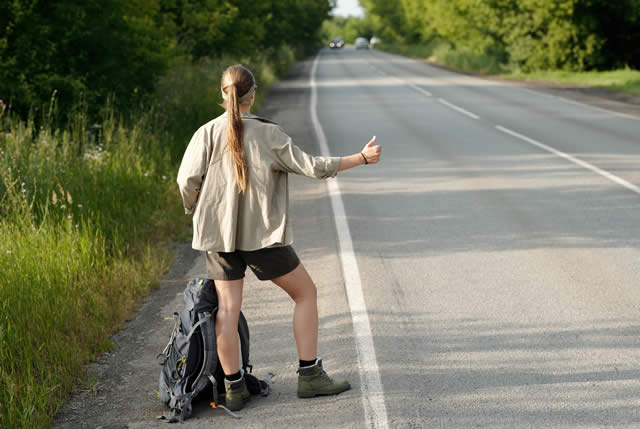
Standing at the edge of a highway with your thumb out sounds romantic until you’re actually wondering whether the next car that stops will get you to your destination safely.
If you’re weighing hitchhiking against other budget travel options, here’s the honest answer: hitchhiking can be reasonably safe when practiced with care in the right regions, but it carries real variability that safer alternatives simply don’t.
This guide walks through what makes hitchhiking risky, where it tends to work out better, the warning signs worth heeding, and the alternatives that might suit your trip just as well.
A Growing Appetite For Budget Travel
More travelers are stretching their budgets further these days, and hitchhiking has resurfaced as one option among many. It costs nothing but time and a bit of nerve, which makes it appealing to backpackers and long-term travelers alike.
But the question worth sitting with before you step onto the roadside is whether the savings are worth the unpredictability that comes with getting into a stranger’s car.
This piece offers a grounded, expert look at the safety considerations involved and the alternatives available, so you can make a choice that fits your comfort level and your journey.
What Makes Modern Hitchhiking Risky
According to Hitchwiki’s community-maintained safety page, hitchhiking is generally reported as "usually very safe," with most incidents hitchhikers describe relating to a driver’s driving style rather than anything more sinister. High-profile dangerous incidents do exist, but they’re the exception rather than the rule based on community reporting.
Still, risk shows up in several forms. There’s the obvious one: getting into a vehicle with someone you’ve never met, whose intentions and driving habits are unknown to you.
There’s also the matter of vehicle reliability, since not every car that stops is in great mechanical shape. And there’s the simple unpredictability of the road itself, from weather shifts to detours that take you somewhere you didn’t plan to go.
Safety also varies enormously by region, country, and even the specific stretch of road you’re standing on. A spot that feels welcoming in one country might feel uneasy in another, and local driving culture, infrastructure, and community trust all play a part.
This is why blanket statements about hitchhiking being "safe" or "unsafe" rarely hold up. Context matters more than the act itself.
Stranger danger is a real factor, and there’s no getting around the fact that every ride involves a judgment call made in a matter of seconds. Hitchwiki recommends a short conversation with the driver before getting in, long enough to get a read on their state of mind and intentions, as a basic vetting step that costs nothing but a moment of patience.
Where Hitchhiking Tends To Be Safer
Some regions have built reputations, largely through community-reported experiences, as more welcoming and lower-risk for hitchhikers.
The Nordic countries, including Iceland, Denmark, Norway, Sweden, Finland, Åland, and the Faroe Islands, appear frequently in hitchhiker community discussions as comparatively safer destinations, according to Hitchwiki’s Nordic Countries overview.
Finland offers a useful case study. Hitchwiki describes hitchhiking there as "quite safe," noting that common sense remains a hitchhiker’s best tool regardless of location. Hitchhiking is legal anywhere a pedestrian may lawfully stand, though it’s illegal directly on motorways, so hitchhikers use on-ramps near bus stops or petrol stations instead.
One traveler’s 2024 report on Hitchwiki rated ease of hitchhiking in Finland at 2 out of 5, citing long waits and drivers who rarely stop outside designated areas, but also noted that those who did stop were excellent.
This captures something important: safety and convenience aren’t always the same thing. A country can feel secure while still testing your patience.
It’s worth being clear that these regional impressions come from community-reported experiences on platforms like Hitchwiki rather than formal crime statistics tied specifically to hitchhiking. No verified government data currently compares hitchhiking risk by country, so these insights should be treated as useful but anecdotal guidance rather than hard numbers.
Community trust factors, such as a culture of looking out for travelers and a general sense of social reliability, seem to play a meaningful role in why certain places earn a reputation as gentler for hitchhikers.
Red Flags Worth Taking Seriously
Every seasoned hitchhiker develops a mental checklist, whether they realize it or not. Hitchwiki’s guidance points to several concrete signs that should prompt a traveler to decline a ride outright. Slurred or erratic speech, a lack of eye contact, and visible open alcohol containers in the vehicle are all signals of possible intoxication, and none of them are worth overlooking for the sake of convenience.
Trusting your gut deserves more credit than it often gets. If something about a driver or vehicle feels off, that instinct is a legitimate safety tool, not an overreaction. Hitchwiki explicitly recommends trusting instincts and declining a ride if it seems unsafe, even if there’s no single obvious reason why.
A practical framework helps turn instinct into action. Before accepting a ride, a brief conversation about where the driver is heading and whether they can drop you at a service area or a known safe point near your destination gives you useful information and a sense of their intentions.
Hitchwiki suggests seeking rides at petrol stations specifically because they offer more time to assess a driver before committing to the car. And importantly, never commit to the full distance of a ride upfront. Keeping that option open means you retain the ability to ask to stop early if the situation changes.
Safer Alternatives Worth Considering
If the unpredictability of hitchhiking doesn’t sit well with you, several alternatives offer similar affordability with considerably more structure. Ride-sharing apps like Uber have built safety features directly into the experience.
Uber’s PIN verification system, for instance, lets riders confirm they’re getting into the correct matched vehicle by requiring the driver to confirm a PIN before the trip begins, with an option to apply this specifically during night-time rides.
Organized carpooling platforms take a different approach to building trust. BlaBlaCar, a well-known carpooling network, incorporates identity verification, detailed passenger ratings, and reviewable profiles that accumulate over time, according to third-party reviews and app store descriptions.
This creates a layer of accountability that traditional hitchhiking simply doesn’t offer, since both drivers and passengers build a visible track record.
For travelers prioritizing cost above all else, budget bus networks across Europe remain a strong option. According to a City Voyager Hub guide on budget travel in Europe, long-distance buses, including services like FlixBus and BlaBlaBus, are often the cheapest way to cross the continent, with fares frequently landing between €10 and €30 per journey. Train travel, while typically pricier, adds comfort and speed to the equation.
Weighing these options comes down to what you value most on a given trip. Choose ride-sharing apps if verified driver identity and built-in safety checks matter more to you than cost savings.
Choose carpooling networks if you want some of hitchhiking’s social spontaneity paired with reviewable accountability. Choose budget buses or trains if minimizing risk entirely outweighs the appeal of free transportation.
Best Practices If You Choose To Hitchhike
If you decide hitchhiking is right for your trip, a few preparation steps go a long way toward reducing risk. Hitchwiki recommends sharing details of the vehicle, including registration number, make, model, and colour, with a trusted contact before getting in.
Sharing your live location through a tool like Google Maps adds another layer of accountability, giving someone outside the vehicle visibility into where you are in real time.
Timing and visibility matter more than many travelers expect. Daylight hitchhiking is considerably safer than hitchhiking at night, according to Hitchwiki, and standing well back from the travelled road so you’re visible from roughly 100 meters away helps drivers approach safely.
Wearing bright or reflective clothing improves visibility further, and at night, carrying reflectors and a small torch makes a meaningful difference.
Keep your essentials close. Hitchwiki advises keeping your passport, wallet, money, and phone on your body rather than in a bag, and keeping your backpack on your lap rather than stowed in the trunk if you’re traveling alone, so you retain full control of your belongings and can exit quickly if needed.
Sitting in the front seat and confirming that doors open from the inside before the vehicle starts moving are small habits that preserve your ability to leave a situation that turns uncomfortable.
Knowing your emergency numbers before you need them is one of those details that’s easy to forget until it matters. Hitchwiki lists 112 for the EU, 911 for the United States, 000 for Australia, 111 for New Zealand, and 999 for the United Kingdom, noting that a text message or a silent call can work when speaking aloud isn’t safe.
Female-presenting hitchhikers in particular are encouraged to apply this guidance with extra diligence, stay aware of their exact location at all times, and have a clear plan for calling for help if needed.
Making The Call That Fits Your Trip
Hitchhiking isn’t inherently reckless, but it isn’t risk-free either. The safety of any given ride depends heavily on region, preparation, and the judgment calls made in the moment a car pulls over.
Community-reported experiences suggest that places like Finland and other Nordic countries tend to offer a gentler experience, though patience is often still required, and no destination removes risk entirely.
If you do choose to hitchhike, treat preparation as non-negotiable. Share your plans, trust your instincts, and never feel obligated to stay in a vehicle that doesn’t feel right.
If the uncertainty doesn’t appeal to you, ride-sharing apps, carpooling networks, and budget buses offer dependable alternatives that still keep your trip affordable. Whichever path you choose, let your own comfort level guide the decision as much as your budget does.
- Hitchwiki. "Hitchhiker’s Safety." Retrieved October 2026. https://hitchwiki.org/en/Hitchhiker%27s_safety
- Hitchwiki. "Finland." Retrieved October 2026. https://hitchwiki.org/en/Finland
- Hitchwiki. "Nordic Countries." Retrieved October 2026. https://hitchwiki.org/en/Nordic_Countries
- City Voyager Hub. "Europe by Bus 2026: FlixBus, BlaBlaBus & Eurolines Guide." https://cityvoyagerhub.com/en/budget-travel/europe-by-bus-flixbus-eurolines-guide/
image credit: envato.com
Comments